WORTH ANOTHER GO? THE EDITORIAL VERDICT
Into the Breach
A precise tactical loop where another squad tests whether a lesson from the previous timeline can become a flexible habit.
Game facts
- Developer
- Subset Games
- Publisher
- Subset Games
- Released
- 27 February 2018
- Platforms
- Windows · macOS · Linux (Steam edition)
- Model
- Paid game
- PEGI
- 12 · Bad Language — Steam UK listing
- Players
- Single-player
- Length
- Short
- Difficulty
- 4 / 5 · Challenging
- Steam Deck
- Verified
PEGI source ↗ · Steam Deck status source ↗
Edition: Base game
The score, explained
The interest and responsiveness of the core decisions and actions.
How progression, exploration and goals fit together.
The coherence of the visual, musical and narrative presentation.
How clearly the game explains its rules and offers useful ways to engage.
The depth of optional goals, alternative approaches and reasons to return.
Change the squad and change the question
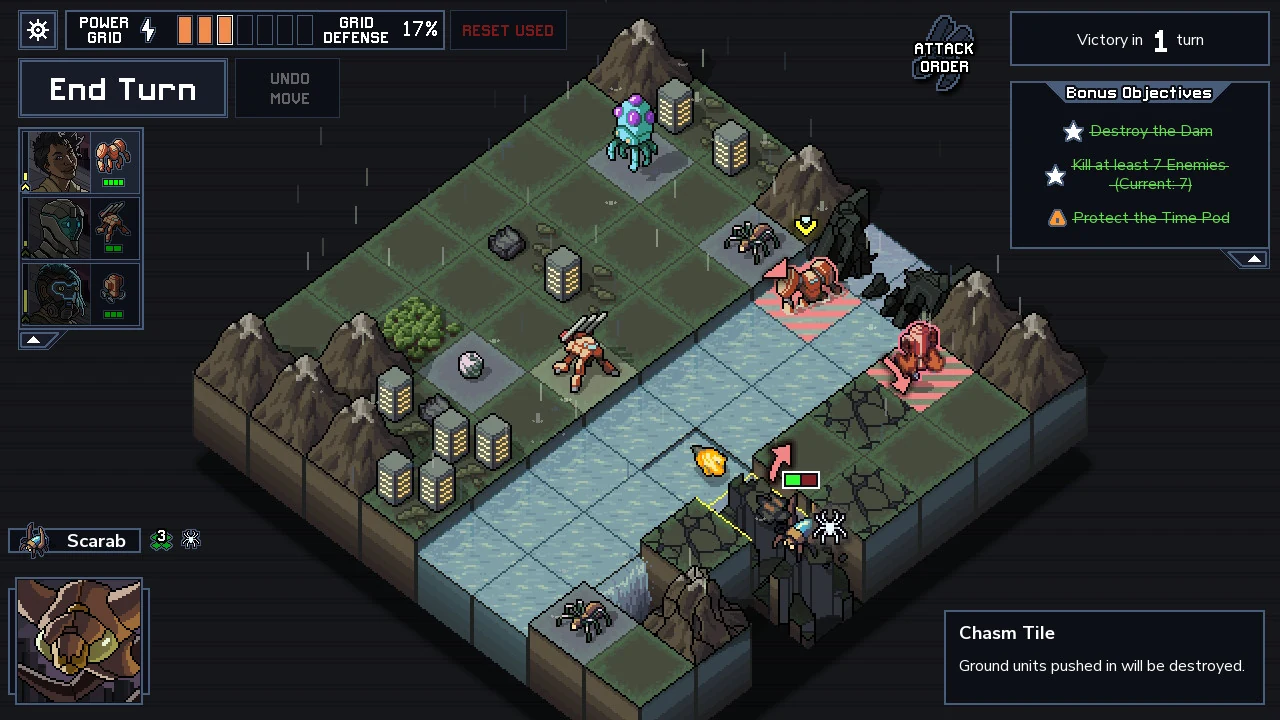
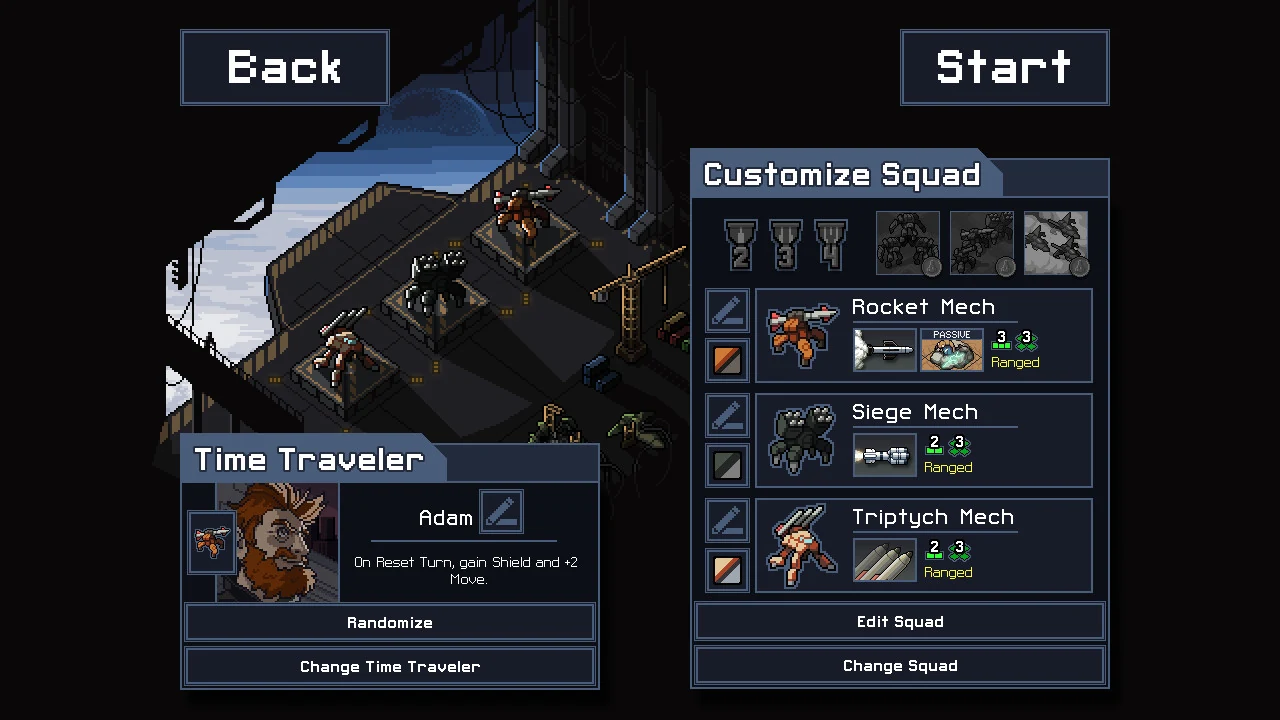
Into the Breach makes returning interesting by changing the tools available to solve an already understandable problem. The Vek threaten buildings and units, their intentions are visible, and three mechs must rearrange the situation before those attacks resolve. A different squad changes the natural first answer. One arrangement may favour direct damage, while another relies more heavily on pushing, fire or the relationship between attacks. That gives a familiar mission type another tactical character without requiring a larger board or a complicated new interface. For Replay Brook, the strongest reason to return is this shift in habits. The player recognises what must be protected, yet has to reconsider which apparently modest action can create enough room for the rest of the turn to work.
Knowledge survives when the timeline does not
Campaigns are finite, and a failed attempt can send a surviving pilot into another timeline. That small continuity reinforces the broader fact that the most important thing carried forward is understanding. Enemy behaviour, mission priorities and the consequences of movement become easier to recognise across runs. Different islands and squad options then test whether that knowledge can be used with another set of resources. The limited turn reset also supports careful reconsideration inside a battle, making an error something to examine rather than only accept. This is a replay structure built around improving judgement. There is less emphasis on endlessly enlarging a permanent character sheet than on becoming more capable of reading a small, dangerous arrangement and finding a practical response before committing the mechs to it.
Clarity can make a mistake feel particularly final
Because the threats are visible, losing an important building often makes the overlooked consequence obvious. That is useful for learning but can also make a defeat feel harsher than a loss attributed to hidden information. Some boards require choosing what to sacrifice, which can frustrate players who expect every tactical puzzle to offer a spotless solution. The limited scale and restrained presentation also place almost all of the emotional weight on the decisions themselves. There is little spectacle to distract from an unsuccessful turn. The game is therefore a stronger fit for someone who enjoys reviewing a sequence than for a player who wants immediate action or persistent rewards to soften every defeat. Its satisfaction depends on finding the next correct judgement meaningful in its own right.
A compact loop for improving tactical habits
Choose Into the Breach when you want another run to test a recognisable skill under changed conditions. Squad differences make the return substantial, while the clear boards let the effect of learning remain visible. A move that once seemed useful only for damage may become a way to block a spawn, redirect an attack or preserve the grid. Those discoveries create a strong sense of development without requiring numerical hours or a large collection of equipment. It suits patient players who like a campaign with a definite outcome and can accept starting another after a loss. Within this selection, its particular strength is precision: a short sequence of actions can express a great deal of understanding, and another squad can immediately ask whether that understanding is flexible enough to travel.
The verdict
A precise tactical loop where another squad tests whether a lesson from the previous timeline can become a flexible habit.
Reasons to play
- Squads change the natural first solution
- Visible threats make learning traceable
- Finite campaigns give attempts clear outcomes
Reasons to think twice
- Some boards demand a sacrifice
- Clear information can make mistakes feel stark
See the game
Assist & accessibility
Explore the available settings and control options on the official game page before choosing your setup.
Parents’ guide
Players: Single-player. No in-game purchase marker in the checked Steam listing. Separate downloadable content may be sold.
Age classification: 12. Bad Language Steam UK listing
A useful starting tip
Look for a move that prevents several attacks through displacement before assuming every threat must be destroyed this turn.
A different direction
Compare this with FTL: Faster Than Light: A gripping expedition loop in which the ship's identity, uncertain opportunities and emergency decisions create a memorable account of each attempt.
Official sources
Reviewed: November 2026
You might also like
 HadesRead review →
 Dead CellsRead review →
 Enter the GungeonRead review →