
WORTH ANOTHER GO? THE EDITORIAL VERDICT
Against the Storm
A distinctive builder whose completed settlements make room for another changing problem, keeping adaptation at the centre of returning.
Game facts
- Developer
- Eremite Games
- Publisher
- Hooded Horse
- Released
- 8 December 2023
- Platforms
- Windows (Steam edition)
- Model
- Paid game
- PEGI
- 12 · Bad Language, In-Game Purchases — Steam UK listing
- Players
- Single-player
- Length
- Long
- Difficulty
- 4 / 5 · Challenging
- Steam Deck
- Playable
PEGI source ↗ · Steam Deck status source ↗
Edition: Base game
The score, explained
The interest and responsiveness of the core decisions and actions.
How progression, exploration and goals fit together.
The coherence of the visual, musical and narrative presentation.
How clearly the game explains its rules and offers useful ways to engage.
The depth of optional goals, alternative approaches and reasons to return.
A new town begins with different priorities
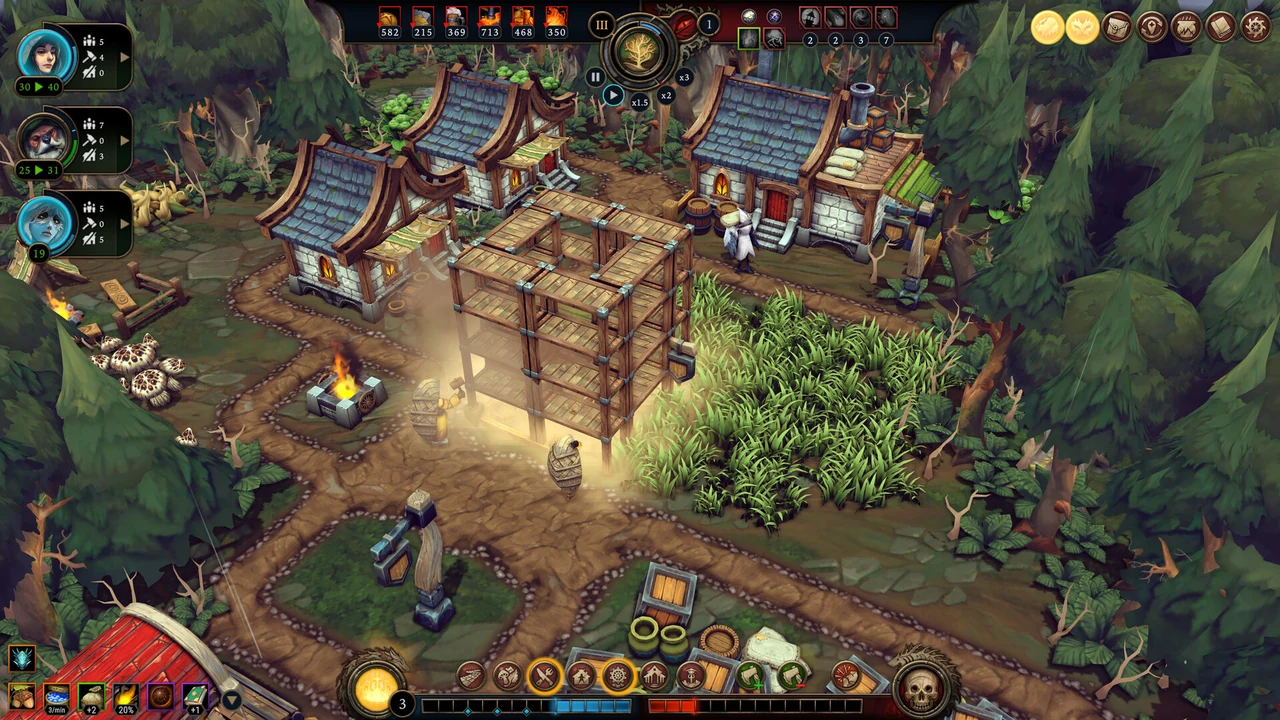
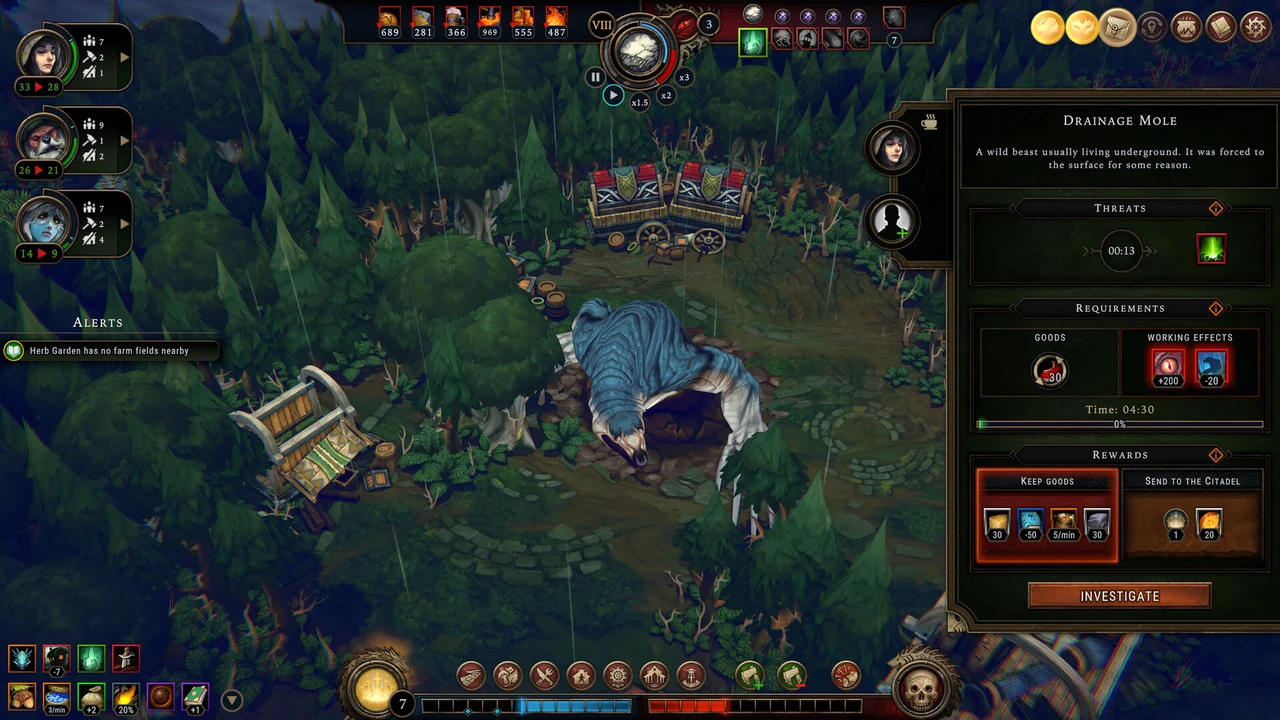
Against the Storm makes repetition part of city building by asking the player to establish and complete settlements rather than maintain one town indefinitely. Each departure brings a new combination of resources, populations and available blueprints. That changes the first useful production chain and the pressures that deserve attention. The appeal for Replay Brook is immediate: restarting does not simply repeat the same opening layout before reaching the interesting part. The opening itself is the changing problem. A building that solved the previous settlement may be unavailable or poorly matched to the present one, encouraging the player to use accumulated knowledge flexibly. The forest provides another source of uncertainty, with glades offering opportunities and demands that can redirect a plan while it is still taking shape.
Permanent development supports temporary experiments
The wider progression gives expeditions continuity, while each settlement retains its own conditions for success. Species needs, orders, resolve and hostility all influence what a particular town should prioritise. A player can carry knowledge of recipes and production relationships forward without being able to reproduce the same economy every time. That balance is the core of the replay value. Familiar systems make a new town understandable, but restricted choices require another arrangement of them. Opening a glade or committing workers to a building becomes a decision about the current expedition rather than an investment in a permanent ideal city. A completed settlement therefore feels like an argument successfully resolved, leaving room for the next departure to pose a different version of the same broad survival question.
Starting over needs to feel like a reward
Players who enjoy becoming attached to one carefully decorated city may find the settlement cycle difficult to embrace. Completion means moving on, and the broader progression does not preserve the same sense of living inside a single place forever. The number of recipes and conditional effects can also make repeated openings demanding until the systems become familiar. A poor understanding of priorities may produce a town that appears busy while failing to address the pressure that actually threatens it. This is a game that rewards diagnosis and adaptation more than decorative continuity. The recommendation is strongest when a fresh set of constraints feels energising. If restarting mainly feels like losing work already done, the unusual structure may resist the very pleasure you most want from a builder.
Choose repeated settlements as repeated solutions
Against the Storm suits players who like to discover why an economy works under particular conditions. Its short-lived towns keep the important decisions close enough to their consequences that a new expedition can test a revised approach. The changing options encourage attention to what is available rather than frustration over an ideal building that has not appeared. It also provides a different tempo from the combat runs elsewhere in this collection, replacing reflex pressure with connected production and population problems. Choose it when completion and departure can be satisfying parts of construction. The lasting progression is not just an expanded set of options, but a better ability to recognise which modest chain of decisions will let this settlement succeed before the next one asks for something different.
The verdict
A distinctive builder whose completed settlements make room for another changing problem, keeping adaptation at the centre of returning.
Reasons to play
- Fresh blueprints prevent automatic openings
- Populations change economic priorities
- Expeditions give construction a satisfying endpoint
Reasons to think twice
- The cycle limits attachment to one town
- Recipe complexity makes early attempts demanding
See the game
Assist & accessibility
Parents’ guide
Players: Single-player. Includes optional in-game purchases.
Age classification: 12. Bad Language · In-Game Purchases Steam UK listing
A useful starting tip
Plan around the populations and production options you actually receive rather than forcing the same settlement blueprint every time.
A different direction
Compare this with Hades II: A layered action loop that makes returning an opportunity to connect a revised setup with more confident control of space and Magick.
Official sources
Reviewed: November 2026
You might also like
 HadesRead review →
 Dead CellsRead review →
 Enter the GungeonRead review →